
Jenday Conure for Sale
Conure Jenday for Sale
Jenday Conure for Sale, the jenday conure is originally from the woodlands, palm groves, and thick vegetation found in the northeastern part of Brazil. These birds naturally build their nests in tree hollows and usually travel in small groups of about 30 individuals.
Temperament
Jenday conures are naturally playful and affectionate, making them great companions.
While some may form close bonds with one person, most do well with families and accept all members as part of their social group. These birds are very affectionate and enjoy being carried on their owner’s shoulder or inside their shirt. They often seek attention by allowing themselves to be petted and will lower their heads as a sign of affection.
Many people appreciate the jenday conure’s unique appearance and friendly nature.
These social birds require regular interaction and might not be suitable for individuals who cannot dedicate several hours a day to their care. Jenday conures are as intelligent as other parrots and can learn simple tricks or mimic sounds.
Speech and Vocalizations
Jenday conures are capable of mimicking human speech like larger parrots, but most do not typically “talk.” However, they are known for repeating household sounds such as telephone rings or microwave beeps. When flying in groups, they make a lot of noise, often calling out to each other. They may also scream when they feel ignored.
How to Teach Your Pet Bird to Talk
Jenday Conure Colors and Markings
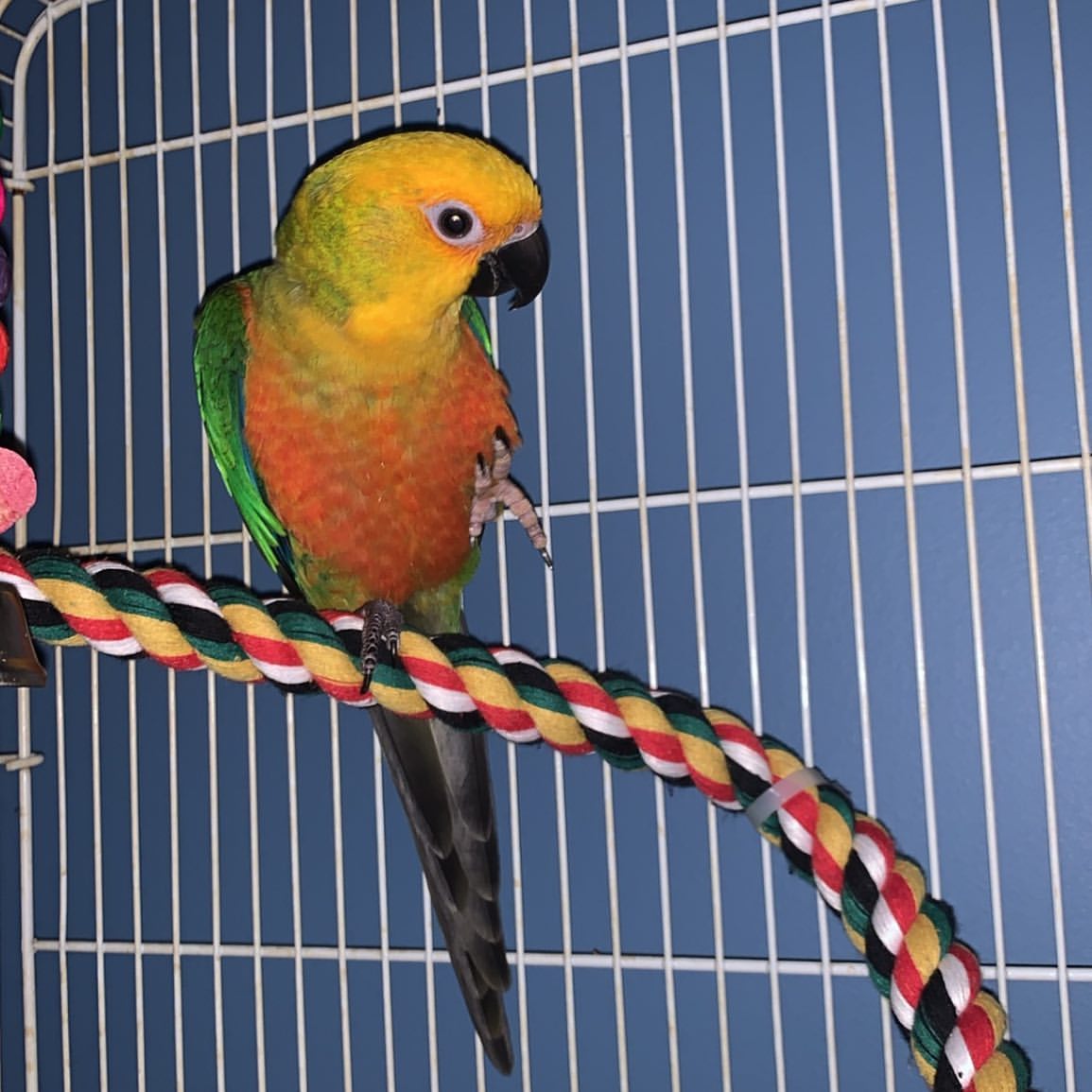
Jenday conures have vibrant feathers with a red-orange body, green wings and back, and a blue tail. Their wings also have a shimmering blue edge. They are sometimes called yellow-headed conures because of their yellow heads and orange facial markings.
They have black beaks and gray feet.
Males have dark brown eyes with a white eye ring, while females have light brown eyes with a gray eye ring. These differences alone are not enough to identify the gender. Jenday conures are similar in size and look to sun conures.
However, jendays have green wings, while sun conures have mostly yellow wings.
Caring for Jenday Conures
Although they are small enough to fit in a cockatiel-sized cage, they need more space. If you’re housing a pair, the cage should be twice as big. Jenday conure pairs stay affectionate and well-behaved when both receive proper attention. They can live with other conures, such as sun, gold-capped, and blue-crowned conures.
Common Health Problems
Jenday conures are hardy and adjust well to home environments. However, they are vulnerable to several diseases:
– Psittacosis (a bacterial infection of the respiratory system)
– Beak malocclusion (an overgrown beak)
– Aspergillosis (a fungal infection)
Signs that a jenday conure is unwell include fatigue, loss of appetite, difficulty breathing, and feather loss or plucking. If you notice these symptoms, consult an avian veterinarian.
Diet and Nutrition
In the wild, jenday conures mainly eat fruits, nuts, and seeds. In captivity, they require a balanced pelleted diet with added nuts, seeds, and fresh fruits and vegetables. Provide an unlimited supply of pellets, as they eat only what they need. Offer 1/8 to 1/4 cup of fresh fruits and vegetables each morning and evening. Always keep their food and cage clean to avoid parasitic infections.
Exercise
Like other conures, jendays need enough space to fly, explore, and play.
They should be out of their cage for at least two hours every day. These birds can learn to use a play stand with ropes, toys, and safe trinkets. Ensure the out-of-cage time is in a safe area away from hazards like pets, ceiling fans, or open windows to avoid escape. Inside the cage, provide items like swings that jendays will use as a resting place. Ladders, bells, and ropes can create an environment that feels like a jungle gym.

Kevin Griggs –
I would highly recommend Kent Birds.