Description
Mynah Bird for Sale
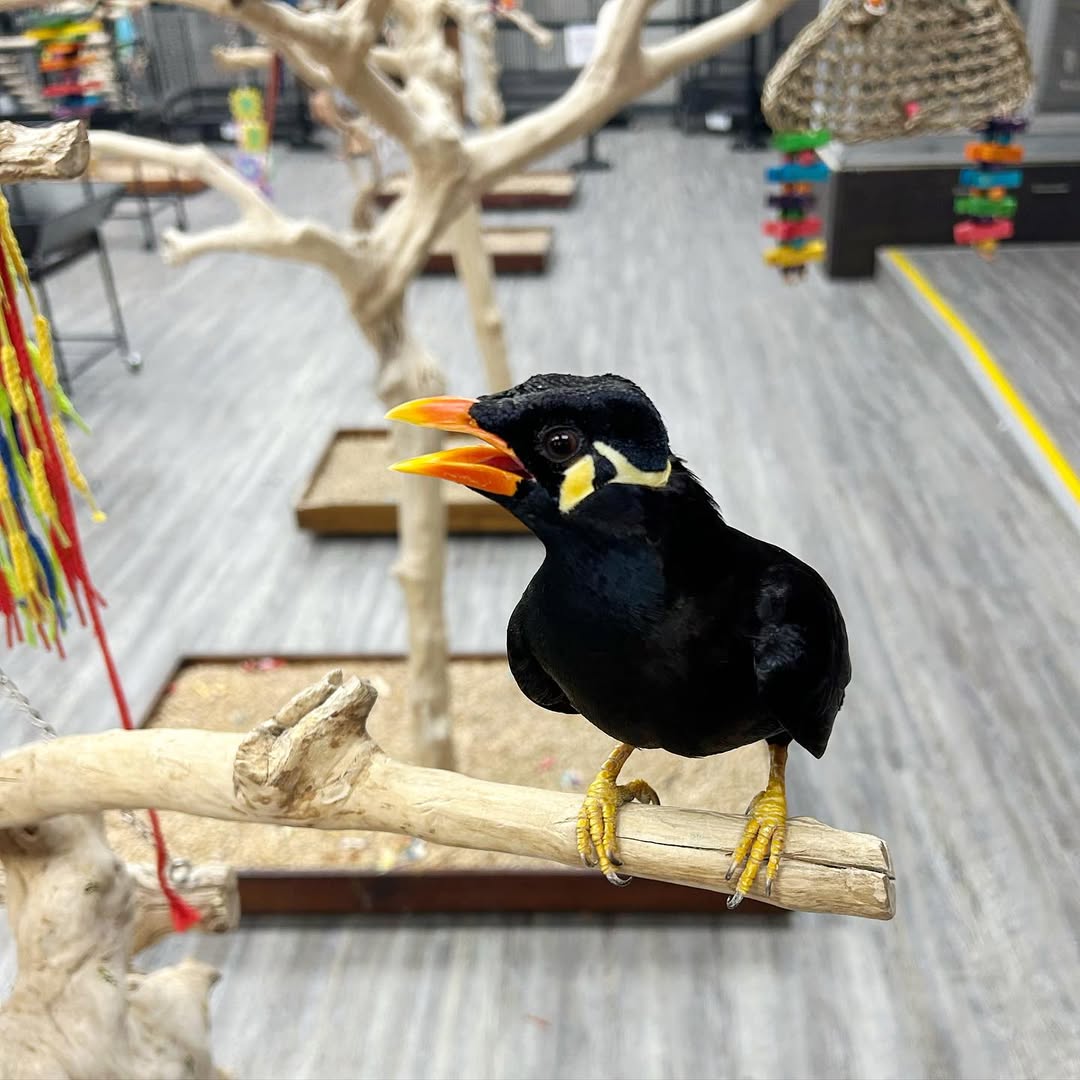
Hill Mynah Bird for Sale
Mynah Bird for Sale Mynah birds belong to the Sturnidae family, commonly known as the starling family. They are a type of softbill bird, originally found in Africa, India, Southeast Asia, and Indonesia.
Temperament
Mynah birds are energetic, social, and enjoy being around people.
They are friendly, intelligent, and thrive in cages, making them great pets that can also breed in captivity. Young birds are easy to train and tame, and they enjoy interacting with humans, though they are not typically affectionate or interested in learning tricks.
Young mynahs adapt quickly to new surroundings. It is important to expose them early to different people, including both genders and various age groups, as well as new environments such as car rides, visits to the vet, and exploring different rooms in the house. A mynah tends to bond most strongly with the person who gives it the most attention, engages in speech training, and takes care of its cage.
Mynahs may attack smaller birds, so it’s best to keep them separate if you have multiple bird species.
Speech and Vocalizations
Keeping a mynah as a pet means you can expect more than just simple repetition.
These birds have a wide range of vocalizations like the african grey parrot in mimicking human speech and environmental sounds, including whistling, screeching, and various sounds that resemble human speech.
They can learn up to 100 words. The key to training your bird to talk is patience and consistent repetition. Choose a word or phrase you want it to learn and say it clearly and repeatedly.
Mynah Bird Colors and Markings
The Bali mynah, which is rare and endangered, has a white body with black wingtips and tail, blue around its eyes, and a yellow beak. Both males and females look the same, and there is no reliable way to tell them apart without genetic testing or by observing which one lays eggs.
Caring for the Mynah Bird
Mynah birds are very active and enjoy moving from perch to perch.
They need a large cage, at least 4 feet wide, 2 feet tall, and 2 feet deep for a single bird. The cage should have multiple perches of different sizes, widths, and textures to encourage foot exercise.
Include a nest box for the bird to rest in. Place the cage away from drafts and cover it at night to avoid cold air. Avoid putting the cage near the kitchen, as mynahs are sensitive to smoke and strong smells.
Mynahs enjoy taking baths, so provide a bowl of warm water deep enough for them to splash in.
Bathing helps remove dust, dander, and loose feathers from their feathers, and it adds moisture. Homes with air conditioning or heating systems can dry out a bird’s skin, so you can also mist your mynah with a spray bottle. Avoid putting the bird in the shower, as the water pressure may be too strong.
Common Health Problems
Mynah birds are prone to certain liver issues and a condition called hemochromatosis, or iron storage disease. careful to manage how much iron you feed your bird.
Diet and Nutrition
In the wild, hill mynahs mainly eat fruit, while common mynahs are omnivores, consuming fruit, nectar, and insects.
In captivity, feed your mynah a softbill pellet mix containing 18% protein, 8% fat, and very little iron to help prevent iron-related diseases.
Pellets should make up about 50% of their diet.
Avoid feeding too many bananas due to their high sugar content. Do not give dried fruits high in iron like raisins. Remove seeds from fruits, as they can be poisonous. Also avoid green vegetables high in iron, such as peas, green beans, sweet potatoes, and broccoli. Cut all fruits and vegetables into small pieces because mynahs do not chew their food.
Supplement the diet with mealworms, crickets, or waxworms.
For breeding pairs, mealworms should be at least 5% of the diet and available for the mother to feed the young.
As a general guideline, start with 1/4 cup of pellets and 1/4 cup of fruits and vegetables daily.
Adjust the amount as needed. Remove any uneaten food and do not leave it overnight.
Stuart Allen –
Very lovely birds
I would definitel recommend
Joseph Okelley –
my mynah parrot arrived calm and healthy. It adapted to its new home very quickly. I highly recommend pet bird breeders
Joseph Kujawa –
The seller kept me updated throughout the process and made me feel confident about my purchase. My new parrot is healthy, beautiful, and already learning new words
Howard S. Mahaffey –
Excellent online buying experience. The pet bird seller was trustworthy and responsive, and my parrot arrived safely and in great condition. I would gladly purchase from pet bird breeder again
Matthew Stone –
I was impressed by the professionalism and attention to detail. The bird was well-socialized, healthy, and exactly what I was looking for.
David M. Hosking –
The seller exceeded my expectations. They provided detailed information about the parrot and offered helpful advice after the purchase. Highly recommended
Crystal Colby –
Excellent experience buying from pet bird breeders online. The seller communicated clearly, and my parrot arrived safely and exactly as described. Very happy with my purchase
Mary Hall –
Absolutely thrilled with my new parrot! The entire process was simple and professional. My mynah bird arrived healthy, playful, and full of energy