
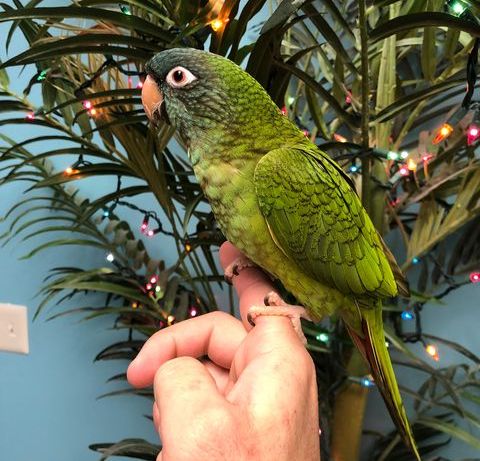
Description
Blue Crown Conure for Sale
Baby Blue Crown Conure for Sale
Blue Crown Conure for Sale They typically live in areas such as open grasslands, wooded regions, and the edges of forests. They do not usually inhabit dense, moist forests.
Temperament
Blue-crowned conures are smart and full of energy.
Like other conures, they require a lot of mental activity and physical exercise to stay happy and avoid becoming bored or restless. These birds are affectionate and enjoy forming strong bonds with their owners who provide them with care and attention.
They are also very trainable. You can teach them to bring back items, turn around, or wave. The most effective way to train them is to ignore unwanted behaviors and reward good behaviors with attention and treats. However, no training can make a naturally loud bird quiet. Trying to scold the bird when it screams may actually make it louder.
Speech and Vocalizations
They tend to be noisy in the early morning and late evening, which could cause disturbances for people living nearby. While conures generally do not speak as much as other parrot species, the blue-crowned conure is one of the better talkers among conures. They can learn to say several words and short phrases.
Blue-Crowned Conure Colors and Markings
Both male and female blue-crowned conures look the same in color and pattern.
When they are born, their heads are a reddish color, but by the time they reach maturity, their heads turn bright blue. These birds have a combination of green feathers on their bodies, a blue head, red-tipped tail feathers, pink legs, horn-colored beaks, and white rings around their eyes.
The physical differences are not easy to see. Males might have larger white eye patches than females, and the feathers above their nostrils (called ceres) may be longer in males.
Caring for the Blue-Crowned Conure
The blue-crowned conure is a highly social bird that usually lives in flocks in the wild.
In captivity, you need to act as its social companion. If you are away for long periods during the day, the bird may do better with another bird like Budgies for company but not with any species larger than that. It might also like having the TV or radio on when you are not at home.
Conures like to curl up in things like tightly woven fabric, soft blankets, or small tents.
They might even want a bird tent for sleeping. In the wild, conures bathe daily, and in captivity, they should have a bath at least once a week, and more often if possible. Bathing them with a gentle spray of warm water helps keep their feathers and skin healthy. It also counts as quality time with your bird.
Common Health Issues
Feather picking is a common issue among conures, often due to lack of attention and stimulation.
Spend time talking to your bird, train it, or teach it to speak.
The blue-crowned conure, like other conures, is also at risk for various health problems, including:
– Proventricular Dilatation Disease: affects the nervous and digestive systems.
– Psittacine Beak and Feather Disease: affects the beak, feathers, and nails.
– Psittacosis: a bacterial respiratory infection.
– Aspergillosis: a fungal respiratory infection.
Diet and Nutrition
In the wild, blue-crowned conures eat a wide variety of foods, including fresh fruits, vegetables, nuts, berries, and grains. In captivity, their diet should include similar items.Pellets should make up about 75 percent of their daily food intake. Offer around a quarter cup of pellets per day, and adjust based on how much your bird eats. Most conures eat about 20 percent of their body weight each day. Feeding them mostly seeds and nuts can lead to health problems.
Feed fresh foods once or twice a day, and remove any leftovers after the feeding time.
Blue-crowned conures are active in the early morning and may be hungrier after a long night. You may also feed them again just before dusk, as wild conures forage for their last meal of the day.
Exercise
Blue-crowned conures have a lot of energy and enjoy being out of their cage, interacting with people throughout the day. You should prepare to spend at least 3 to 4 hours each day with your bird, allowing it to move around freely and interact with you. Provide a play structure outside the cage where it can stretch its wings.
If you won’t be releasing your bird from the cage often, make sure it has a spacious cage (around 36 inches on each side) filled with toys it can chew.
Providing chew toys is important to keep the bird stimulated and prevent it from chewing on inappropriate items like wires, furniture, or woodwork.
Jose Tapia –
We bought a Blue Crown Conure from Pet bird breeders. Very knowledgeable, kind and caring staff. Will always appreciate and recommend Pet bird breeders.
Francis Allmon –
I have 2 Blue Crown Conure which were purchased at Pet bird breeders. I truly appreciate all the staff for their knowledge, caring and competence. Additionally, the management staff have always been so helpful and knowledgeable when we got our bird the first day.
christina gatt –
Do you deliver to lithuania and around the globe.